
Home » Wholeness Photography
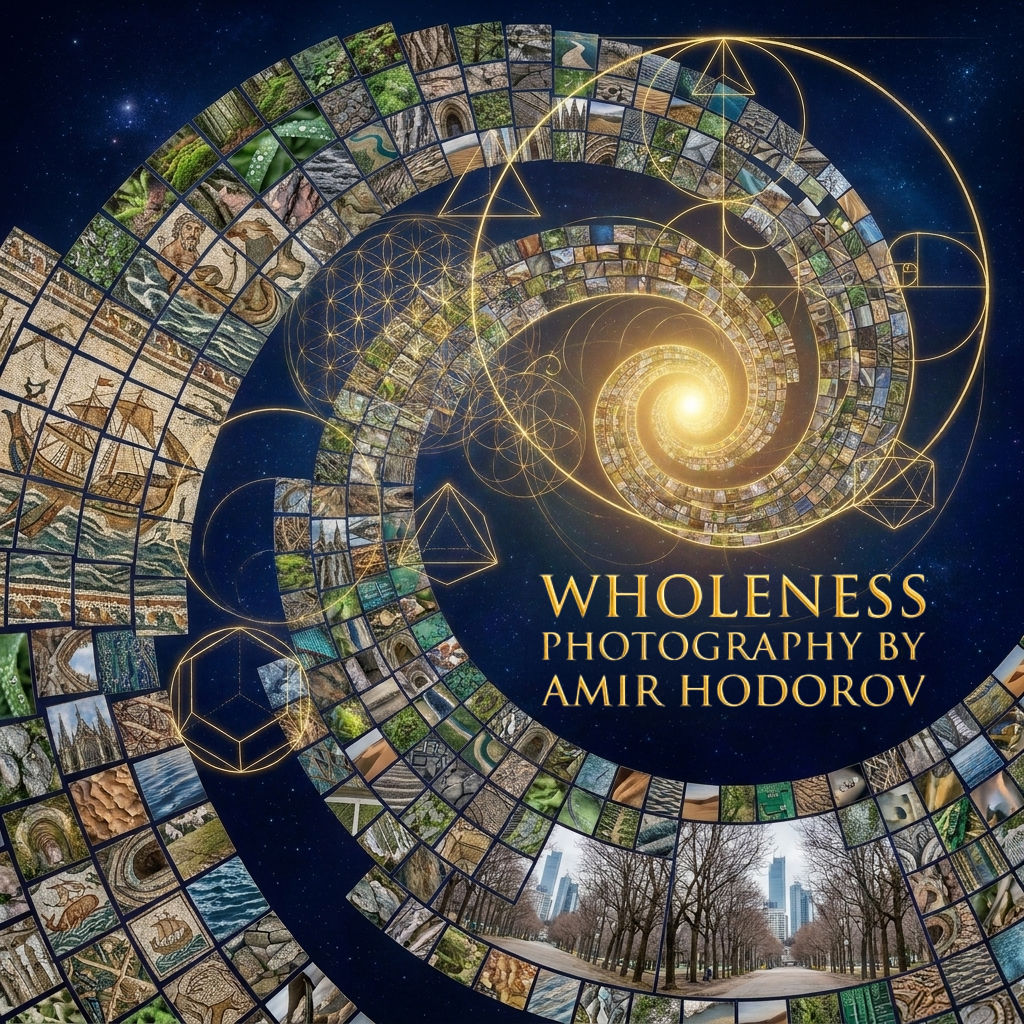
Wholeness Photography
The Great Wholeness of Amir Chodorov
Introduction: A Philosophy of Perfection and Balance
The contemporary world is characterized by aggressive fragmentation, visual noise, and an incessant flow of scraps of disjointed images. Thus, the aspiration for harmony today is not only an aesthetic choice, but also a reflection of an existential human need for “correction.” Against this background, Amir Chodorov has centered his work on the philosophy of “wholeness”; his work is intended not only to provide a response to the human need to bridge the gap between the individual and the collective, but more importantly, to fill the gaps between the fragments of images and the pieces of information that flood our world. To this end, Chodorov has developed the idea of the “Wholeness Photography”, which is not only an artistic practice that builds an image from thousands of images taken from a multitude of angles; it is also an artistic discipline that seeks to transform the “incomprehensible” and the “unknown” into something that is familiar and known. For the viewer, who has become accustomed to consuming reality through pieces of small pieces of visual, verbal and auditory information – through fragments of texts and images scattered on social networks and elsewhere – the idea of “Wholeness Photography” offers a cognitive and emotional anchor. It is not just an artistic technique, but rather an aspiration to achieve visual perfection, to create a state of a type of “protected space” of order, in the midst of chaos. This connection, between the inner vision and the external reality, is realized through a work process that consists of dismantling and assembling, a process that converts the decentralized digital image into a continuum of wholeness, through a craftsmanship effort that is both spiritual and Sisyphean.
The Craft of Creating a Modern Mosaic: From the Renaissance Art to the Camera Lens
Chodorov does not “capture” moments, he builds them into a sequence of time and place. In his view, photography is a strategic act of architectural construction, in which each piece is composed of hundreds and sometimes thousands of separate photographs, just like the fragments of which contemporary reality is composed. Each individual photograph is a kind of “pixel” that becomes a philosophical atom in a larger structure, similar to a historical mosaic, that gives the whole a power greater than the sum of its parts. The connection between Chodorov’s work and that of the great Renaissance artists is also not coincidental. In 1553, Ascanio Condivi published an official and approved biography of Michelangelo’s life, written under the full supervision of the maestro himself, and largely based on his direct words. In that text, Condivi claimed that Michelangelo had grown up in a house of stonemasons (scarpellino) and thus absorbed his love of the chisel along with his wet nurse’s milk. As a sculptor-painter, Michelangelo combined, in his work on the Sistine Chapel ceiling, separate narratives – from the Creation to the Great Flood, as well as images of other biblical figures – into a balanced spiritual experience of space and spirit. One strong example of this is his portrayal of the figure of the prophet Jonah; Michelangelo used a sharp perspective to “break” the physical confinement of the curved ceiling, to break through the boundaries of the standard two-dimensional frame, and to create a space in which the multiplicity of details no longer “confuses” the viewer’s perception, and instead only intensifies the perception that the viewer is looking at the truth.
Speaking metaphorically, it can be said that Chodorov, as a “digital stonemason”, extracts the image from mountains of visual information with surgical precision; he uses wholeness as someone who “paves” reality with mosaic pieces; the idea of a mosaic – the assembly of a multi-meaning whole from single, separate sections – has become a powerful philosophical metaphor in Western thought, one that appears in antiquity as well. There is something paradoxical about the mosaic: the artist is seemingly limited to a finite number of pieces that has the ability to restrict the artist’s freedom to create. But in the context of a mosaic’s actual creation, it produces an unexpected wealth of shades, movement, and the illusion of depth. It is precisely the reduction to a finite number of “building blocks” that gives the mosaic its flexibility: the ability to “move a single stone,” and to give it a new meaning within the overall context, makes the medium surprisingly flexible and versatile. It is no coincidence, then, that thinkers in all generations, and especially in the ancient world, saw the world itself as a kind of cosmos-mosaic: a tapestry of seemingly separate parts – events, people, destinies – which ultimately make up a harmonious and deliberate cosmic pattern (logos), even if from the individual point of view, the overall pattern is not visible. Similarly, memory and history themselves can also be seen as a mosaic: just as the physical mosaic is usually preserved in only partial fragments and still gives us a true picture, so too our knowledge of the world is a kind of “mosaic” of its own: fragments of testimonies, partial texts, from which we try – carefully and meticulously – to reconstruct a complete picture.
The medium is the message: the camera as an extension of the brain
According to Marshall McLuhan’s teaching: “The medium is the message”. This is made obvious in Chodorov’s work, in which technology is not only a technical tool, it is an extension of the artist’s brain and perception; this is a perception that makes it possible to translate an internal spatial vision into a tangible reality. In a world of “noise media”, the very method of work – the Sisyphean collection of a thousand fragments and their organization into a single unit – is a message of unity and synthesis. Chodorov acts as an “artist who dictates reality” and not necessarily as a reflection of reality. He cleans up the optical distortions and failures of ordinary lenses in order to create a “corrected reality.” This is where the connection to the Renaissance’s concept of ideal beauty occurs: the artist does not reproduce nature as it is, but rather “perfects” it in order to reveal the higher and organized truth hidden within it.
The transition from a photographer who documents to a designer of perspective allows the viewer to experience a space in which the eye and mind wander undisturbed, within a reality that is simultaneously familiar but perfect in a way that cannot be achieved by an ordinary human gaze.
The Geometry of the Spirit: Divine Harmony and Cosmic Order
It is thus not surprising that the beauty of Chodorov’s works is anchored in the mathematics of the universe. As Pythagoras, Euclid, Plato, and Kepler taught us, geometry and mathematics are the languages in which nature’s text has been written. Chodorov’s perfection rests on the “signature of cosmic harmony”, i.e., the golden laws: the use of the golden ratio (Phi – 1.618), the Fibonacci sequence, and the golden angle (137.5°). These patterns, which appear in nature, for example in cones and sunflowers, ensure an infinite division without overlap or “holes”, and explain why the work feels “right” and soothes the viewer biologically and instinctively. In this spirit, Chodorov’s work echoes the “theory of the three spheres” and the wisdom of the Platonic “solids” – i.e., the five perfect geometric bodies (the tetrahadron, the cube, the octahedron, etc.) that Plato linked to the elements of the universe in “Timaeus”. A particularly profound insight is the discovery that the ratio between the outer (blocking) sphere and the inner (blocked) sphere is exactly the same for all Platonic bodies. This is the mathematical code of absolute equilibrium. For example, space is hyperbolic, that is to say, nature does not build straight, linear grids but rather – a hyperbolic space. Thus, Chodorov, in his control of lens distortions, actually returns photography to the organic, non-linear truth of nature. The use of these laws transforms photography into a work that not only represents aesthetics, but reflects the divine order that hides beneath the surface of matter.
Summary: An invitation to visual meditation
The encounter with “Wholeness Photography” is an invitation to what is now called “continued looking” or “slow looking”. In a reality that sanctifies the fast and the superficial; Amir Chodorov’s works thus offer a space of visual meditation. They invite the viewer to stop, breathe, and perform an “internal correction” through observation. The viewer is invited to seemingly get lost in the thousands of small details – the pixels that are the building blocks of the modern mosaic – in order to finally find the “great wholeness.” It is a moment of reconnection to the great harmony of the world, in which mathematics becomes the spirit and photography becomes a prayer of order and beauty. Nature acts as a great mathematician – and art is the reflection of that wholeness.
- Elhanati